

Unsichtbare Chöre - Choeurs Invisibles: exploring the world of Karlheinz Stockhausen
Unsichtbare Chöre - Choeurs Invisibles- Album Overview
Released in 1970, "Unsichtbare Chöre - Choeurs Invisibles" is a significant work by the avant-garde composer Karlheinz Stockhausen, known for his pioneering contributions to electronic music and spatial sound. This album, released under the Deutsche Grammophon label, showcases Stockhausen's exploration of the relationship between space and sound, utilizing innovative techniques that challenge traditional musical forms. The recording features a series of compositions that integrate both live and recorded voices, creating a unique auditory experience that immerses the listener in a soundscape of ethereal choral textures.
Stockhausen collaborated with various vocalists and musicians to craft this album, pushing the boundaries of vocal performance. The album is notable for its extensive use of spatialization, where sounds are not just heard but experienced in a three-dimensional auditory environment. The tracks, while not easily categorized within conventional genres, embody elements of contemporary classical music and experimental sound art, reflecting the cultural shifts of the late 1960s and early 1970s.
Notably, "Unsichtbare Chöre" highlights Stockhausen's interest in the metaphysical aspects of music, drawing connections between sound and the invisible forces that shape human perception. The album's artistic vision aligns with Stockhausen's larger body of work, which often seeks to redefine the listener's experience and understanding of music. This release serves as a crucial piece in the puzzle of Stockhausen's oeuvre, illuminating his innovative spirit and the evolution of modern music.
Review
"Unsichtbare Chöre - Choeurs Invisibles" stands as a testament to Stockhausen's avant-garde vision and his ability to transcend mere auditory experience. The album's soundscape is both haunting and ethereal, with choral elements layered in ways that create a sense of depth and texture rarely encountered in traditional choral works. The manipulation of vocal sounds, blending organic harmonies with electronic manipulation, draws listeners into an immersive experience that feels both otherworldly and profoundly human.
Despite the lack of conventional structure, the album captures the essence of Stockhausen's artistic philosophy, emphasizing the exploration of sound as a medium of expression. The lack of lyrics allows the voices to transcend language, functioning more as instruments than mere carriers of meaning. This invites listeners to engage with the music on a visceral level, feeling rather than interpreting. Stockhausen's genius lies in his ability to create a sonic environment that encourages reflection and contemplation, making this album not just a collection of tracks but a holistic experience.
Highlights
- Innovative use of spatialization that enhances the listening experience.
- Unique blend of vocal techniques and electronic manipulation.
- Profound exploration of sound as a metaphysical entity.
Weak points
- The abstract nature may alienate traditional music listeners.
- Lack of conventional structure could be seen as disorienting.
- Limited accessibility due to its avant-garde approach.
Overall evaluation
"Unsichtbare Chöre - Choeurs Invisibles" is a landmark album that encapsulates Karlheinz Stockhausen's revolutionary approach to music. While it may challenge conventional listening habits, its rich texture and innovative spirit make it a rewarding experience for those willing to engage with its complexities.
Personal rating: 8/10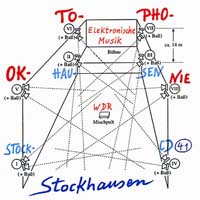 1994Oktophonie
 1980Donnerstag aus Licht
 1969Hymnen
 1960Kontakte