

First impressions of Karlheinz Stockhausen – Elektronische Musik 1952–1960
Elektronische Musik 1952–1960- Album Overview
"Elektronische Musik 1952–1960" is a groundbreaking compilation of electronic works by the influential German composer Karlheinz Stockhausen. Released in 1964 under the Deutsche Grammophon label, this album features a collection of Stockhausen's pioneering electronic compositions, which were developed during the early years of electronic music. The album showcases works that were primarily created at the Cologne Studio for Electronic Music, where Stockhausen was a key figure in the evolution of this avant-garde genre. The tracks on this album exemplify Stockhausen's innovative techniques, including the manipulation of sound through tape editing, synthesis, and spatialization. Notable compositions such as "Studie I" and "Studie II" serve not only as artistic expressions but also as experiments in sound that challenge traditional musical structures. The album stands as a testament to the composer's ability to merge technology with artistry, pushing the boundaries of music as it was known in the mid-20th century. Stockhausen's vision extended beyond mere sound; he sought to explore the spatial dimensions of music, which can be heard in the way he arranged sounds across the stereo field. Collaborators at the Cologne studio, including renowned engineers and fellow composers, contributed to the technical aspects of the recordings, allowing Stockhausen's avant-garde ideas to flourish. This album is not only significant for its historical context but also for its lasting influence on genres such as electronic, experimental, and contemporary classical music.
Review
The soundscapes presented in "Elektronische Musik 1952–1960" are nothing short of revolutionary. Stockhausen's pioneering approach to electronic music creates a rich tapestry of textures and timbres that invite listeners into a world vastly different from traditional musical forms. The use of tape manipulation and synthetic sounds in compositions like "Studie I" evokes a sense of unpredictability and exploration, making the listener acutely aware of the medium itself. The album lacks conventional melodies or lyrics, instead focusing on pure sonic experience. This abstraction can be both liberating and daunting, allowing for personal interpretation while challenging the listener's expectations. Stockhausen's artistic vision is evident in his meticulous attention to detail and the spatial arrangement of sounds, which often feel as though they are enveloping the listener. However, the dense and unconventional nature of these compositions may not resonate with all listeners, particularly those accustomed to more traditional forms of music. Yet, for those willing to immerse themselves in Stockhausen's radical aesthetic, the experience can be profoundly rewarding, offering insight into the possibilities of sound and music.
Highlights
- Innovative use of electronic sounds that transformed the landscape of modern music.
- Pioneering techniques in sound manipulation and spatialization.
- A rich historical context that showcases the evolution of electronic music in the 20th century.
Weak points
- May be challenging for listeners unfamiliar with avant-garde or electronic music.
- Lack of traditional structure or melody may deter some audiences.
- Some pieces may feel overly abstract, risking listener engagement.
Overall evaluation
"Elektronische Musik 1952–1960" is a landmark album that encapsulates Karlheinz Stockhausen's groundbreaking contributions to the realm of electronic music. It is both a historical document and a bold artistic statement that continues to inspire musicians and composers today.
Personal rating: 8/10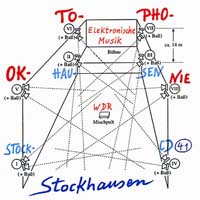 1994Oktophonie
 1980Donnerstag aus Licht
 1969Hymnen
 1960Kontakte