ALBUM NOTESListening to Oktophonie by Karlheinz Stockhausen-Oktophonie
Album overview
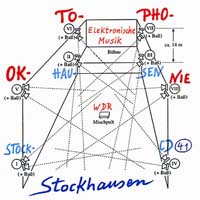
Oktophonie is a groundbreaking work by German composer Karlheinz Stockhausen, first released in 1991 as part of his larger series of compositions focusing on spatial music and electronic soundscapes. This album was created for an eight-channel sound system, reflecting Stockhausen's innovative approach to the spatialization of sound, which allows listeners to experience music as a three-dimensional auditory event. The recording was made at the WDR Studio for Electronic Music in Cologne, showcasing Stockhausen’s commitment to pushing the boundaries of traditional composition.
The album is significant not only for its technical achievements but also for its artistic vision, as it exemplifies the post-war avant-garde movement that sought to redefine the relationship between sound, space, and human perception. It features various sonic textures and intricate layering of sounds, highlighting Stockhausen's mastery in blending acoustic instruments with electronic manipulation. Collaborators on the project include sound engineers and musicians who were integral to the realization of Stockhausen's complex auditory ideas.
Despite being a challenging listen for some, Oktophonie has been influential in the fields of contemporary classical music and sound art, inspiring a generation of composers and sound designers to explore new methods of sound creation and presentation. The album captures the essence of Stockhausen's philosophy on music as a spatial and temporal experience, making it a crucial work in the canon of 20th-century music.
Review
Listening to Oktophonie is akin to entering a sonic laboratory where sound is not just heard, but felt and experienced. Stockhausen's intricate layering and manipulation of sound create an immersive environment that challenges the listener’s perception of music. The album lacks traditional melodies or lyrics, instead offering a tapestry of sounds that evoke various emotions and images. This absence of conventional structure may alienate some listeners, yet it invites others to engage deeply with the work and contemplate the nature of sound itself.
The spatial quality of the recording is particularly noteworthy, each sound appears to move through the space around the listener, which is a testament to Stockhausen's pioneering work in electronic music. His artistic vision is clear: music is not merely an auditory experience but a physical one, shaping how we interact with our environment. The deliberate use of silence and sudden bursts of sound adds to the drama, making Oktophonie a profound meditation on auditory perception.
Highlights
- Innovative eight-channel sound design enhances the listening experience.
- Masterful blending of acoustic and electronic elements.
- Significant cultural impact on contemporary classical music and sound art.
Weak points
- May be challenging for listeners unfamiliar with avant-garde music.
- Lacks traditional structure, which could alienate some audiences.
- Requires focused listening to fully appreciate the nuances.
Overall evaluation
Oktophonie is a seminal work that exemplifies Stockhausen's innovative spirit and commitment to exploring the boundaries of sound. While it may not cater to everyone's tastes, it stands as a testament to the power of music as a transformative experience.
Personal rating: 8/10
```

 2013Amour / Der Kleine Harlekin / Wochenkreis
 1980Donnerstag aus Licht
 1969Hymnen
 1960Kontakte