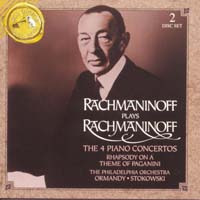
ALBUM NOTESHow Sergei Rachmaninoff shaped the sound of Isle of the Dead / The Bells
Isle of the Dead / The Bells- Album Overview
Sergei Rachmaninoff's "Isle of the Dead / The Bells" was released in 1940, a significant period for the composer as he was transitioning into his later years in America. The album features two of Rachmaninoff's notable orchestral works: "Isle of the Dead," composed in 1909, and "The Bells," based on a poem by Edgar Allan Poe, which Rachmaninoff completed in 1913. This recording showcases the lush orchestration and profound emotional depth characteristic of Rachmaninoff's style.
The album was released under the RCA Victor label, a prominent name in classical music recording during the 20th century. The conductor for this recording was the esteemed Eugene Ormandy, leading the Philadelphia Orchestra, renowned for its rich sound and technical prowess. This collaboration allowed Rachmaninoff's intricate compositions to resonate with a broad audience, enhancing the emotional and atmospheric qualities inherent in both pieces.
"Isle of the Dead" reflects Rachmaninoff’s fascination with the themes of death and eternity, inspired by Arnold Böcklin's painting of the same name, while "The Bells" showcases a choral setting that captures the essence of transition and the passage of time. The album is significant not just for its artistic merit but also for its cultural context, marking Rachmaninoff's continued influence in the realm of classical music during a time when he faced personal and professional challenges as an émigré in the United States.
Review
Rachmaninoff's "Isle of the Dead / The Bells" presents a profound exploration of human emotion and philosophical themes through music. The orchestration in "Isle of the Dead" is masterful, utilizing a rich palette of colors that evoke a haunting atmosphere. The dynamic contrasts and rhythmic intensity create a sense of urgency and reflection, mirroring the themes of mortality and the afterlife depicted in Böcklin's artwork.
In contrast, "The Bells" reveals Rachmaninoff's lyrical genius, with its choral elements weaving seamlessly into the orchestral fabric. The piece is both celebratory and mournful, encapsulating the cyclical nature of life. The emotional crescendos and melodic lines are undeniably Rachmaninoff, revealing his signature ability to blend melancholy with beauty.
This album not only highlights the technical brilliance of the Philadelphia Orchestra under Ormandy's direction but also serves as a testament to Rachmaninoff's enduring legacy in classical music. His ability to infuse deep emotional resonance into orchestral and choral works continues to inspire both musicians and audiences alike.
Highlights
- The lush orchestration and emotional depth of "Isle of the Dead."
- The captivating choral harmonies in "The Bells."
- The exceptional performance by the Philadelphia Orchestra under Eugene Ormandy.
Weak points
- The album may feel dense for listeners unfamiliar with Rachmaninoff's style.
- Some may find the themes of death and mortality overwhelming.
- The recording quality, while good for its time, may not meet modern standards.
Overall evaluation
"Isle of the Dead / The Bells" is a profound exploration of life, death, and the human experience, beautifully rendered through Rachmaninoff's masterful compositions. It remains a powerful representation of his artistic vision and a significant contribution to classical music.
Personal rating: 9/10