
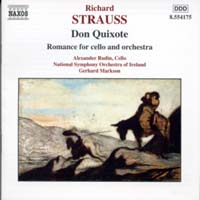
Richard Strauss – Strauss: Don Quixote / Schoenberg: Concerto: a sonic journey
Strauss: Don Quixote / Schoenberg: Concerto- Album Overview
The album "Strauss: Don Quixote / Schoenberg: Concerto," released in 2017 under the prestigious Deutsche Grammophon label, features two monumental works that showcase the innovative spirit of their respective composers, Richard Strauss and Arnold Schoenberg. This recording is performed by the renowned Berlin Philharmonic, under the baton of the acclaimed conductor, Sir Simon Rattle. The album includes Strauss's "Don Quixote," a tone poem that is a vivid orchestral depiction of Miguel de Cervantes's legendary character, along with Schoenberg's "Concerto for String Quartet and Orchestra," which represents a pivotal shift towards modernism in classical music. The recording sessions took place at the Philharmonie in Berlin, a venue known for its exceptional acoustics, allowing the intricate textures of both works to shine. The collaboration between Rattle and the orchestra brings an exciting dynamic to the performances, making each note resonate with clarity and emotional weight. "Don Quixote" serves as both a narrative and a musical exploration of the themes of chivalry and illusion, while Schoenberg’s concerto challenges traditional forms and embraces dissonance, reflecting the turmoil of the early 20th century. The album's significance lies not only in its artistic merit but also in its historical context, bridging late Romanticism with early modernism. The release has been well received, with critics praising the interpretative depth and the high-quality production values, marking it as a noteworthy addition to the catalogs of both composers.
Review
This recording of "Don Quixote" is a striking manifestation of Strauss's ability to blend narrative with orchestral color. The Berlin Philharmonic's performance is rich in detail, with each instrument contributing to the vivid storytelling. The cello, representing Don Quixote, delivers a poignant performance that captures the character's nobility and folly. Rattle’s direction ensures that the orchestral textures are perfectly balanced, allowing the listener to appreciate the intricate interplay between soloists and the orchestra. In contrast, Schoenberg's "Concerto" showcases a different musical language, brimming with complexity and innovation. The string quartet's interaction with the orchestra creates an engaging dialogue, challenging the listener to embrace the dissonances and rhythmic intricacies that characterize Schoenberg's style. The overall sound quality is exceptional, benefiting from Deutsche Grammophon's meticulous production, which highlights the nuances of each piece. The album, through its juxtaposition of Strauss's lyrical storytelling and Schoenberg's avant-garde explorations, invites listeners to traverse a broad spectrum of emotions and musical ideas.
Highlights
- Outstanding orchestral performance by the Berlin Philharmonic.
- Impeccable sound quality and production values enhancing the listening experience.
- Rich emotional depth in Strauss's "Don Quixote," showcasing a masterful blend of narrative and music.
Weak points
- Schoenberg's "Concerto" may be challenging for listeners unaccustomed to modernist compositions.
- Some may find the juxtaposition of styles jarring rather than complementary.
- The album could have benefited from additional contextual notes or liner notes for deeper understanding.
Overall evaluation
"Strauss: Don Quixote / Schoenberg: Concerto" is a compelling exploration of two distinct musical worlds, executed with precision and passion by the Berlin Philharmonic. The album not only highlights the technical prowess of the performers but also the rich narratives embedded in Strauss's and Schoenberg's compositions. It stands as a testament to the evolution of classical music, making it a worthwhile listen for both aficionados and newcomers alike.
Personal rating: 8.5/10 1986Elektra
 1978Salome