
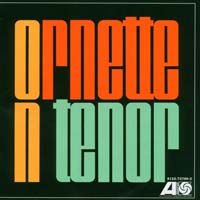
First impressions of Ornette Coleman – Ornette on Tenor
Ornette on Tenor- Album Overview
"Ornette on Tenor," released in 1962, marks a significant point in the career of avant-garde jazz pioneer Ornette Coleman. This album showcases Coleman's transition from alto saxophone to tenor saxophone, offering a fresh perspective on his innovative sound. Released by the esteemed Blue Note label, the album features a stellar lineup of musicians, including Don Cherry on trumpet, Charlie Haden on bass, and Ed Blackwell on drums, all of whom were integral to Coleman's revolutionary approach to jazz.
The recording sessions took place in 1961, a time when Coleman was already renowned for his unorthodox style that challenged traditional jazz norms. The album features six tracks, including standout pieces like "The Ark" and "Lonely Woman," which exemplify his signature free jazz style characterized by improvisation and emotional depth. Coleman’s experimentation with harmony and rhythm on this album reflects the cultural upheaval of the 1960s, as jazz began to break free from its conventional roots and embrace a more avant-garde identity.
Despite being overshadowed by some of his earlier works, "Ornette on Tenor" is crucial in understanding the evolution of Coleman's music. It encapsulates a moment when jazz was expanding its boundaries, and Coleman's contributions were pivotal in that transformation. The album did not produce commercial singles but remains a significant artistic statement in Coleman's discography, further solidifying his legacy as one of the 20th century's most influential musicians.
Review
The sound of "Ornette on Tenor" is both bold and introspective, a testament to Coleman's artistic vision. The tenor saxophone allows Coleman to explore deeper emotional textures, with a warmth that contrasts with the sharper edge of his alto sax. This album is less about melody and more about the exploration of sound and feeling, inviting listeners into a world of spontaneous creativity. The interplay between Coleman and Cherry is particularly notable, as their dialogues through their instruments create a rich tapestry of sound. The rhythmic foundation provided by Haden and Blackwell allows for a fluidity that enhances the overall improvisational feel of the album.
While lyrics are absent, the music itself conveys profound messages, capturing the essence of human experience through free expression. Coleman's artistic vision transcends mere technical proficiency; it's about conveying emotion and breaking down barriers. In a genre often defined by structure, "Ornette on Tenor" serves as a bold declaration of freedom, inviting listeners to embrace the unexpected.
Highlights
- Innovative use of the tenor saxophone, showcasing a new dimension of Coleman's artistry.
- Exceptional collaboration between musicians, creating a rich, improvisational sound.
- Significant cultural impact, reflecting the evolution of jazz during a transformative era.
Weak points
- May be challenging for traditional jazz listeners due to its avant-garde approach.
- Less cohesive structure compared to some of Coleman's earlier works.
- Limited commercial appeal, which may affect accessibility for casual listeners.
Overall evaluation
"Ornette on Tenor" stands as a bold statement in Ornette Coleman's discography, showcasing his innovative approach to jazz through the tenor saxophone. While it may not resonate with all listeners, its significance in the avant-garde jazz movement is undeniable.
Personal rating: 8/10 2021The Shape Of Jazz To Come (bonus Track Version)
 1977Dancing in Your Head
 1972Skies of America
 1959Tomorrow Is the Question!
 1959The Shape of Jazz to Come