
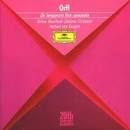
Carl Orff experiments boldly on De Temporum Fine Comoedia
De Temporum Fine Comoedia- Album Overview
"De Temporum Fine Comoedia," composed by Carl Orff, was released in 1973. This innovative work is a dramatic cantata that explores themes of time and existence through a unique blend of classical and contemporary musical forms. Orff, who is best known for his popular work "Carmina Burana," takes a bold step in this composition, delving into a more avant-garde and experimental sound.
The album was recorded under the Deutsche Grammophon label, featuring a rich orchestration that includes a large choir, soloists, and an array of instruments that contribute to its dramatic and poignant atmosphere. The recording sessions brought together a diverse group of musicians, which helped to create a vibrant and dynamic interpretation of Orff's vision.
"De Temporum Fine Comoedia" is structured in multiple movements, each reflecting different aspects of time and its implications on human life. The text, derived from various sources, including medieval Latin literature, adds a layer of complexity and depth to the music. This work stands as a significant cultural commentary, merging Orff's interest in the human experience with his innovative approach to rhythm and melody.
Though it did not produce mainstream singles like "Carmina Burana," this album is noteworthy for its artistic ambition and philosophical exploration. It pushes the boundaries of traditional classical music while remaining accessible to audiences, showcasing Orff's bold experimentation in the realm of modern choral works.
Review
The sound of "De Temporum Fine Comoedia" is a complex tapestry of orchestral textures and choral harmonies, embodying a sense of urgency and introspection. Orff’s use of rhythm is particularly striking, employing driving percussion to evoke the relentless passage of time. The choral writing is both powerful and lyrical, allowing the text's philosophical musings to resonate deeply with listeners. The interplay between soloists and choir creates a dramatic contrast, enhancing the emotional weight of the piece.
Artistically, Orff’s vision is ambitious; he seeks to challenge conventional perceptions of time and mortality. The lyrics, rich with symbolism, invite interpretation and reflection, making the work not just a musical experience but a philosophical journey. However, some may find the abstract nature of the text and the non-linear structure challenging, which may alienate listeners expecting a more traditional narrative arc.
Highlights
- Innovative blend of classical and contemporary styles
- Powerful choral arrangements that enhance emotional depth
- Thought-provoking themes that invite reflection on time and existence
Weak points
- Abstract lyrics may be challenging for some listeners
- Non-linear structure could feel disorienting
- Lack of mainstream appeal compared to Orff's more famous works
Overall evaluation
"De Temporum Fine Comoedia" stands as a testament to Carl Orff's creative boldness and willingness to explore complex themes through music. While it may not achieve the same widespread acclaim as his earlier works, it remains an important contribution to the choral repertoire, showcasing his innovative spirit and artistic depth.
Personal rating: 8/10 2019Choral Works
 1993Antigonae
 1960Carmina Burana
 1954Catulli Carmina