
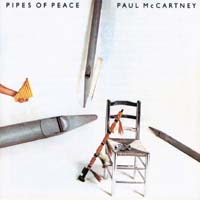
Review of Paul McCartney – Pipes of Peace
Pipes of Peace- Album Overview
"Pipes of Peace" is the fifth studio album by Paul McCartney, released on October 31, 1983, under the Parlophone and Columbia Records labels. This album followed the successful "Tug of War," and was a continuation of McCartney's collaboration with producer George Martin, who had produced most of The Beatles' iconic albums. The recording sessions took place in various locations, including AIR Studios in London, and the album features contributions from a range of artists, including Michael Jackson, who sings on the hit single "Say Say Say." The album explores themes of peace and reconciliation, mirroring the socio-political climate of the early 1980s, during a period marked by the Cold War. "Pipes of Peace" produced several notable singles, including "Say Say Say," which reached No. 1 on the Billboard Hot 100 chart, and the title track, "Pipes of Peace," which also gained significant radio play. The album's sound is characterized by its blend of soft rock, pop, and elements of synth-pop, showcasing McCartney's knack for melodic hooks and catchy choruses. Despite receiving mixed reviews upon its release, "Pipes of Peace" has garnered retrospective appreciation for its ambition and the quality of its songwriting. Lyrically, it reflects McCartney's desire for harmony, making it a culturally relevant album during its time.
Review
The sound of "Pipes of Peace" is a quintessential representation of the 1980s pop landscape, featuring lush production and a polished aesthetic that was characteristic of McCartney's work in this era. The album opens with the vibrant "Say Say Say," a collaboration with Michael Jackson that sets a buoyant tone, showcasing McCartney's ability to blend catchy melodies with commercially viable production. However, the album also contains introspective tracks, such as "The Other Me," which delve into personal themes, demonstrating McCartney's versatility as a songwriter. Lyrically, McCartney oscillates between lightheartedness and deeper social commentary, particularly evident in the title track "Pipes of Peace," where he expresses a yearning for global harmony. While some critics at the time noted a lack of cohesion in the album, it ultimately serves as a testament to McCartney's artistic vision during a time of great personal and global change. The blend of upbeat tracks and reflective ballads creates an engaging listening experience, even if the album feels somewhat disjointed at times.
Highlights
- Memorable collaborations, particularly with Michael Jackson on "Say Say Say."
- Strong melodic hooks that showcase McCartney's songwriting prowess.
- Thematically relevant lyrics that address peace and reconciliation.
Weak points
- Mixed critical reception upon release, with some finding it lacking cohesion.
- Some tracks may feel overly polished, losing raw emotional impact.
- A few songs do not reach the heights of McCartney's earlier works.
Overall evaluation
"Pipes of Peace" stands as a noteworthy entry in Paul McCartney's solo career, illustrating his ability to adapt to the evolving music scene of the 1980s while maintaining his signature style. While it may not be as universally acclaimed as some of his earlier works, it offers a collection of engaging tracks that resonate with themes of peace and personal introspection.
Personal rating: 7/10 2020Mccartney Iii
 2005Twin Freaks
 2005Chaos and Creation in the Backyard
 2001Driving Rain
 1999Run Devil Run
 1997Standing Stone
 1997Flaming Pie
 1995The Family Way
 1995Give My Regards to Broad Street
 1993Off the Ground
 1989Flowers in the Dirt
 1986Press to Play
 1982Tug of War
 1980McCartney II
 1971Ram